
LINTag
High-Throughput Single-Photon-Streaming
LINTag is the time-tagger system for ultra-fast data
acquisition. The time-to-digital converter boasts 8
acquisition channels, each with an adjustable input
threshold and impedance. The system can deliver
over 400 MTags per second with an accuracy of less
than 8.5 ps, transmitting data to your computer via a
10G Ethernet SFP+ connection that uses a full-stack
TCP/IP interface. If your application requires lower
latency, you can utilize the embedded PC to directly
access the time tags from the FPGA.
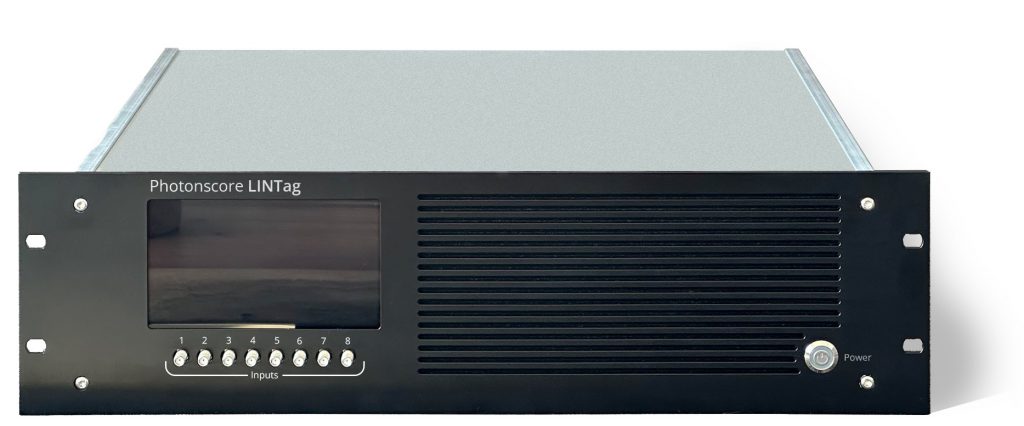
Acquire a high throughput stream of single photon events
Timing Jitter
Temporal accuracy of 8.5ps (FWHM) / 3.6ps (RMS)
Throughput
Transfer up to 400 MEvent/s to your computer
Technical Data
Timing & Processing
|
|
|
||||||||||
|---|---|---|---|---|---|---|---|---|---|---|---|
|
RMS jitter, ps
|
3.6
|
||||||||||
|
FWHM jitter, ps
|
8.5
|
||||||||||
|
Digital bin size, ps
|
1
|
||||||||||
|
Max. input frequency, MHz
|
550
|
||||||||||
|
Tag transfer rate, MTags/s
|
400
|
||||||||||
|
Burst memory, GTags
|
10
|
||||||||||
|
Internal computing capability
|
Intel® 13th Gen. Core™ i7
|
||||||||||
Input
|
Signal Level, V
|
-2 to 2.5
|
|
Impedance, Ohm
|
50 / Hi-Z (1M)
|
|
Polarity
|
Negative / Positive
|
|
Channel number
|
8
|
|
External clock input
|
10MHz, IRIG-B
|
General
|
Power supply
|
24V, 12.5A
|
|
Dimensions, (w × d × h), mm
|
480 × 345 × 133 (3U)
|
|
Connectivity
|
USB 3.0 / Thunderbolt 3 / SFP+ (10G TCP/IP)
|
|
Operating System
|
Windows (64 Bit), macOS, Linux
|