
LINCam
Single photon detection System
Photon counting is the only way to get as much information brought by light as it is physically possible. Here we present the system allowing to detect not only arrival time of individual photons but also a position as straightforward as camera. Standing on the shoulders of night vision technology LINCam allows to extend any simple wide-field microscope to the powerful fluorescence lifetime imaging system.
Acquisition System
Everything one needs for robust and reliable single photon counting in a single box. The acquisition system integrates TDC, analog to digital converters, power suppliers, reference signal constant fraction discriminator and more. Just plug it to an USB 3.0 port, or connect it to the network of your lab and start counting photons.
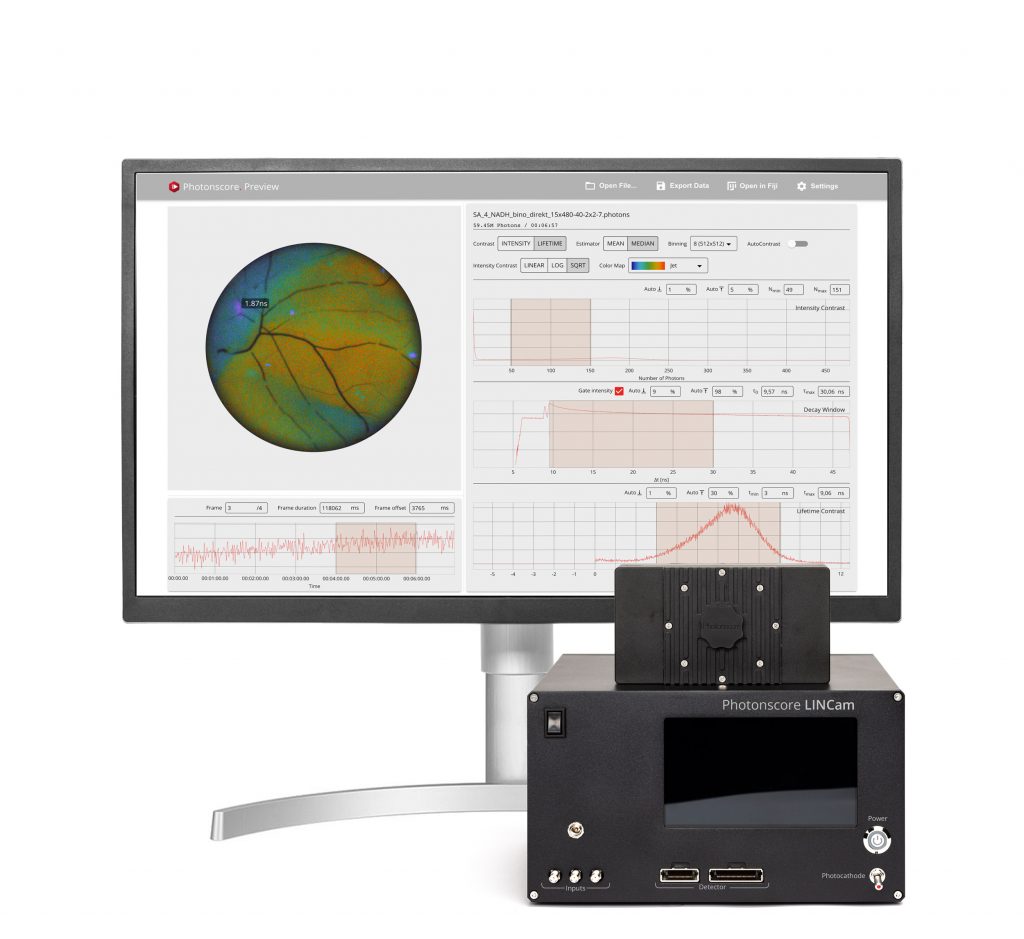
Acquire a high fidelity stream of single photon events
Spatially
Spatial resolution of 1000*1000 pixels
Temporally
Temporal accuracy of 40ps
Countrate
Record up to 1 MEvent/s
Technical Data
Single photon detector
|
|
LINCam
|
||||||||||
|---|---|---|---|---|---|---|---|---|---|---|---|
|
Active area diameter, mm
|
17
|
||||||||||
|
Positional resolution, pixels
|
1000 × 1000
|
||||||||||
|
Temporal resolution, ps FWHM
|
< 40 (Blue, Aqua), < 45 (Green), < 55 (Red)
|
||||||||||
|
Microscope mount
|
C-mount
|
||||||||||
|
Housing dimentions, mm
|
145 × 78 × 50
|
||||||||||
|
Weight, g
|
500
|
||||||||||
|
Cooling
|
Liquid cooled
|
||||||||||
Single photon acquisition system
|
Maximal count rate, MHz
|
1
|
||||||||||
|
Dead time, ns
|
250
|
||||||||||
|
Timing method
|
FPGA based TDC
|
||||||||||
|
Minimum bin width, ps
|
1
|
||||||||||
|
Electrical resolution, ps, FWHM
|
8.5
|
||||||||||
|
Number of bins / Window
|
100 000 or 100ns
|
||||||||||
|
Reference input
|
Positive or negative NIM
|
||||||||||
|
Time tagging resolution, ps
|
1
|
||||||||||
|
Computer interface
|
USB 3.0, Ethernet
|
||||||||||
|
Operating System
|
Windows (64 Bit), macOS, Linux
|
||||||||||